



Mercury’s RH304T: Rethinking Spaceborne Data Storage for a New Era of Satellite Technology


Space has always been an unforgiving environment for space electronics, and expectations placed on orbital storage systems are accelerating faster than legacy architectures can adapt. Modern satellite payloads, from high-resolution optical instruments to advanced scientific sensors, generate torrents of mission-critical data, requiring advanced data and processing.
Yet the physics of space hasn’t changed; as electronics advance, their greater sensitivity, complexity, and density make reliable operation in space challenging. Radiation still threatens every transistor, and the margin for error remains razor-thin.
This tension is reshaping how the industry thinks about space electronics, radiation tolerant design, and the role of storage within next-generation space missions.
The Growing Gap Between Data Ambition and Storage Reality
As low Earth orbit constellations, scientific spacecraft, and deep space probes take on more ambitious roles, the industry is confronting a widening mismatch between what missions need and what traditional storage systems can reliably deliver. Payloads in space now produce data at rates that would have been unthinkable a decade ago.
But the environment remains unforgiving. A single corrupted block or latch-up event can compromise years of planning. This is why the longstanding practice of adapting commercial hardware for orbit is reaching its limits. In modern satellite components, radiation tolerant and radiation-hardened electronics can no longer be engineered after the fact and must be designed into the architecture from day one.
Designing for Radiation from the First Transistor
A new generation of storage solutions are emerging that treat component hardening and fault tolerance as foundational design principles. Mercury’s RH304T solid state data recorder (SSDR) is one example of this shift. Rather than modifying commercial NAND devices for orbit, its architecture is built specifically for radiation-intense environments.
Most components are designed to withstand total ionizing dose levels exceeding 100 krad. Its RTG4-based controller, a radiation-tolerant FPGA, provides configuration upset immunity to LET values greater than 103 MeV·cm²/mg, and the system is engineered to avoid single event latch-up entirely.
This reflects a broader industry movement: understanding the difference between radiation-tolerant vs. radiation-hardened electronics and applying each where it makes the most sense for mission assurance.
Radiation-hardened versus Radiation-Tolerance
Radiation-hardened and radiation-tolerant electronics differ in their ability to withstand radiation. Radiation-hardened components are specifically designed for extreme environments like deep space or nuclear reactors, using specialized materials and processes to resist effects such as total ionizing dose (TID) and single-event effects (SEE).
These systems prioritize reliability over performance, making them ideal for critical applications like spacecraft, though they are more expensive and usually less advanced technologically.
Radiation-tolerant electronics, on the other hand, are standard components adapted to handle moderate radiation levels through techniques such as shielding, redundancy, or error correction. While more affordable and advanced in performance, they carry a higher risk of degradation or failure in harsher environments, making them better suited for missions or systems where some level of risk is acceptable and exposure levels remain within predictable limits.
Error Correction as a Mission Enabler
As storage densities increase, error correction becomes a strategic capability. The RH304T illustrates how far the field has advanced. Its two-pass ECC architecture combines horizontal ReedSolomon algorithms with TLC bitsweep technology, enabling correction of up to 24 errors in every 30 bytes of data.
This isn’t just an incremental improvement. It’s a redefinition of what “acceptable risk” looks like for space technology that must preserve scientific measurements, Earth observation imagery, and mission telemetry over years of radiation exposure.
Performance Expectations Are Evolving Too
Radiation tolerance alone won’t meet the needs of modern payloads. Storage systems must also keep pace with the data rates of increasingly sophisticated instruments — including optical payloads for space missions and advanced radar systems.
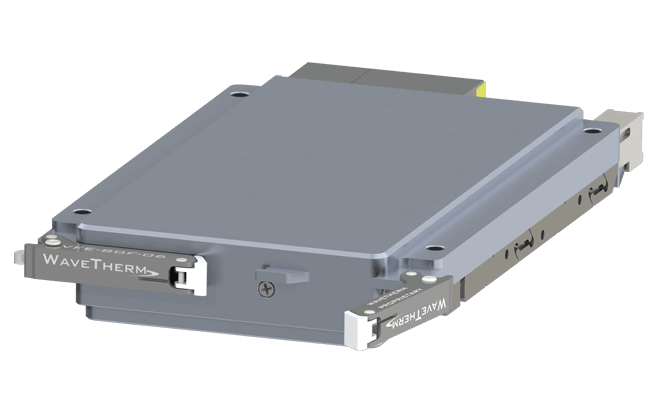
The RH304T demonstrates how performance and resilience can coexist:
- 4.5 TB capacity using industrial-grade NAND flash memory
- Serial RapidIO at 3.125 Gbps
- Up to 16 Gbps throughput in dual port configurations
- 9.2 Gbps write / 8 Gbps read in dual host mode
- A 3U OpenVPX / VITA 48‑compatible package weighing under 750 grams
The adoption of OpenVPX and emerging SpaceVPX standards is reshaping how storage integrates with broader spacecraft architectures, enabling modular, scalable, and fault-tolerant designs across LEO constellations and deep space missions.
Learning From Flight Heritage While Designing for the Future
The industry’s most capable storage systems are informed by real flight experience. Mercury’s prior SSDRs, for example, have supported NASA missions such as the JPL EMIT science mission aboard the ISS.
That heritage shapes the RH304T’s design choices, influencing everything from its use of 3D NAND in SLC mode and automatic block retirement to its power loss protection, multidevice fault tolerance, and advanced defect mitigation strategies.
EMIT’s data demands illustrate why modern spaceborne storage has to be both resilient and high-throughput. As a hyperspectral instrument collecting 285 spectral bands for every pixel it observes, EMIT generates large scene files multiple times per ISS orbit.
Each raw collection then expands into progressively richer data products, from Level 0 telemetry to calibrated radiance, surface reflectance, mineral maps, and gridded global datasets—multiplying the total volume the system must manage.
Over months and years of continuous operation, this creates a sustained pipeline of hundreds of gigabytes to terabytes of mission data.
That real-world workload, with its frequent writes, large file sizes, and long-duration integrity requirements, directly informs the RH304T’s emphasis on radiation-tolerant design, robust fault tolerance, and the use of durable NAND flash memory to deliver the kind of radiation-tolerant memory performance needed for demanding space missions.
Where the Industry Goes Next
As innovation in space technology accelerates, the demand on onboard storage will only intensify. The next generation of systems will need to be:
- Radiation-tolerant by design, not adaptation
- Aligned with OpenVPX and SpaceVPX standards for modularity
- Capable of multi‑gigabit throughput to match modern payloads
- Built on advanced ECC frameworks that anticipate radiation effects
- Supported by proven flight heritage to reduce program risk
Mercury’s RH304T is one example of how the industry is responding. Not with incremental upgrades, but with architectures purpose-built for the realities of space.
The RH304T is available to order today, giving mission designers immediate access to a flight proven architecture, radiation tolerant storage solution built for modern space demands.
To inquire about Mercury Systems’ RH304T for your mission, contact Vincent Pribble and our team of specialists today.



 PEMs in space