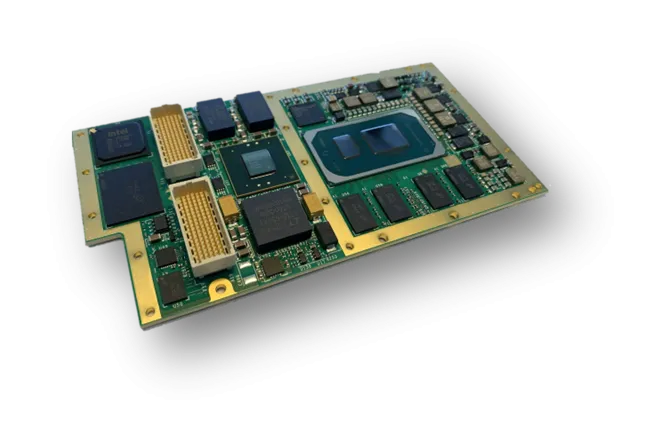
Single Board Computers (SBCs)

Explore Single Board Computers

Filter By Features

+Function
+Form Factor
+Primary processor
+System memory
+Switch fabric
+Option

CLEAR FILTER

MIL_AIR_US_Navy_Growler.jpg

Extreme Ruggedization for the Edge

Mercury’s rugged SBCs are conduction, air, liquid or hybrid cooled and can operate in:

  • -40°C to +85°C temperatures
  • 70,000 ft altitudes
  • 80g, 5-2000 Hz shock and vibration 

Learn more about our MOTS+ rugged embedded packaging.

A single board computer (SBC) is a complete, fully functional computer built on a single printed circuit board. It integrates all essential components into one unified design, including the microprocessor, memory (RAM), storage, and input/output (I/O) interfaces. Unlike typical PCs, it often lacks traditional expansion slots for core functions because everything needed for operation is already "baked" into the board.

  • Integration: Traditional motherboards require separate components (CPU, RAM, GPU) to be socketed or plugged in. SBC has these components soldered directly to the board to reduce failure points and save space.
  • Size & Form Factor: SBCs are typically much smaller (often the size of a credit card or 3.5" disk) and designed for embedded applications rather than general-purpose desktop use.
  • Expandability: Motherboards offer high customization via multiple PCIe slots, while SBCs prioritize a fixed, highly reliable design with specific onboard I/O for task-specific functions.

  • Temperature Resilience: Industrial-grade SBCs are rated to operate in extreme ranges, typically from -40°C to +85°C, whereas consumer boards may fail outside a narrow 0°C to 70°C window.
  • Mechanical Durability: Rugged SBCs use advanced techniques like conformal coating to protect against moisture/dust and staking or underfill to reinforce components against high shock and vibration.
  • Longevity: They use components with guaranteed lifecycles of 10+ years, ensuring long-term availability for mission-critical defense and industrial programs.

  • ARM Architecture: Dominates the market due to high power efficiency and low cost, commonly found in IoT and mobile devices.
  • x86 (Intel/AMD): Used for higher-performance applications requiring Windows compatibility or complex processing, such as Intel Xeon D, Core i7, or Atom processors.
  • FPGAs & Accelerators: Modern rugged SBCs often include FPGAs or dedicated Neural Processing Units (NPUs) for real-time AI and machine learning at the tactical edge.

Affordable, Configurable and Ready to Deploy

Equipped with multiple mezzanine sites and I/O options, SBCs can be quickly tailored to meet your specific application needs. Built with modular open architectures including OpenVPX, VME and SOSA, our SBCs simplify integration and upgrades at a fraction of the cost and time of custom-developed boards. 

PURPOSE-BUILT

Reduce Risk and Deploy Faster

Ruggedized and delivered with DAL artifacts and built-in security features, Mercury’s open system architecture processing and IO boards mitigate risk, reduce subsystem development costs and accelerate platform deployment. 

LEARN MORE

DISCOVER MORE

White Paper: Achieving Full Spectrum Dominance with DRFM Technology

DRFM-based radar environment simulators and radar target generators are efficient, cost-effective...

Read More

Webinar: Direct RF Technology to Advance Edge Digital Signal Processing

Digital #signal processing has been the impetus behind analog to #digitalRF signal conversion for...

Read More

Article: The Inside Story on Direct RF Data Converters

This article discusses a new generation of “Direct RF” data converters, revolutionizing system...

Read More

White Paper: The Need for Direct RF in an Evolving Defense Environment

This white paper describes next generation direct RF to redefine what’s possible in radar and...

Read More

RF Signal Acquisition Demo

Mercury supports the most critical application development with signal chain solutions from a single...

Read More

Delivering RF signal processing solutions to the edge with MOSA

Today's pace of technology development means the traditional approach of custom-designed modules and...

Read More

White Paper: Designer's Journey: Navigating the Transition to AMD Versal™ Adaptive SoC

Optimized to solve the most advanced radar, cognitive EW and AI challenges, learn how Mercury ’s...

Read More

White Paper: A Generational Leap in Edge Computing with the Versal ACAP

SWaP-optimized and ruggedized for operation in harsh environments, learn how Mercury ’s ACAP-based...

Read More